IOTV
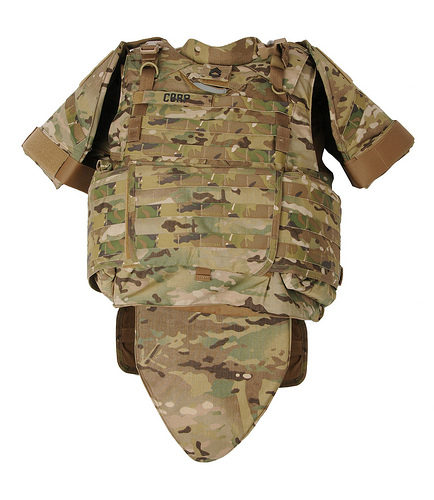


IMPROVED OUTER TACTICAL VEST (IOTV)
Specifications
Developed: 2006-2007
In service: Late 2007-present
Patterns: UCP (2007-2019), OEF-CP (2011-2019), OCP (2019-present)
Materials: Cordura, Kevlar, Twaron, Spacer mesh fabric
Weight: 31.87 pounds (with all plates and components)
Sizes: 11 (X-Small through XXXX-Large)
While the Interceptor Body Armor and the Outer Tactical Vest were considered fairly effective, questions were raised over whether or not they were the best possible armor for American soldiers and Marines. This debate was heightened by controversy over Dragon Skin, produced by the now defunct Pinnacle Armor. It was presented as superior to the previous systems of body armor fielded by the Army and Marines, with its supporters claiming it was the best possible armor and outperformed the IBA. To support their argument, a retired Marine colonel spoke to the media claiming that Dragon Skin was better than other systems. In the spring of 2006, PEO Soldier’s PM Soldier Equipment conducted a series of tests of the Dragon Skin SOV 3000 vest as part of its Soldier Protection Demonstration (SPD). The armor proved to be unable to withstand temperatures of -60 F, 120 F and 160 F.
It failed 4 out of 8 tests with 7.62mm ball ammunition, suffering more than a dozen first or second shot penetrations. Dragon Skin failed to meet the Army’s standards, and was then banned from use by ground troops in Iraq and Afghanistan. After the results of the tests were made public, it became clear that Dragon Skin was a failure and would ultimately never see widespread adoption.But the question as to whether or not Interceptor was the best system for soldiers still lingered. In Iraq and Afghanistan, it was found that soldiers were often hit by enemy fire from the sides, with hits to the torso being among the most common wounds. An interim set of plates for use on the OTV, ESBI, had begun to be fielded, but something better was still needed.
A vest that could give protection to both sides of the wearer’s body, with integrated side plate carriers and the ability to be quickly taken off was desired. A typical set of Interceptor Body Armor with ceramic ballistic inserts weighed a total of 33 pounds, and proved to be quite a burden on soldiers who had to go out in the field with it. The IOTV began with a body armor industry day in the spring of 2006, which subsequently attracted revised designs from vendors, some of which, including Point Blank, manufactured the older OTV. Work on a replacement began not long after the Dragon Skin debacle ended, with researchers eventually creating a new and improved system of body armor that would address the limitations of its predecessor.

April, 2007: A Corporal from the 3rd Infantry
wearing the Advanced Combat Helmet tests
out the new and improved IOTV with deltoid
and ground protectors.
Development of Interceptor’s replacement began in the mid-2000s under PEO Soldier’s Project Manager Soldier Survivability. A number of companies had put forward their own ideas for a potential successor to Interceptor, and before long the first prototypes began to roll off the assembly line. Primary concerns in the development process included adequate protection against most types of small arms, distribution of weight, mobility, and freedom of movement. Extensive trials were conducted, including live-fire tests, along with other tests conducted in a variety of conditions to ensure that the system could be worn in both extreme heat and bitter cold. After the final prototypes were made, PEO Soldier announced in April 2007 that the IOTV would begin fielding to units in Iraq and Afghanistan.
The first orders for the new vest were made in June of that year, and the IOTV began to slowly replace the older Interceptor system throughout the late 2000s. Some regular army, National Guard and Army Reserve units still used Interceptor into the late 2000s and early 2010s, though fielding the IOTV more or less was complete by the end of the decade. The Improved Outer Tactical Vest was a major improvement over the previous Interceptor system, offering greater coverage, more flexibility, and the ability to quickly take it on or off - something Interceptor lacked. It had a number of innovative features, including built-in Kevlar soft armor inserts and side protection, a quick release cable to take off the vest in emergency situations, a more durable waistband, mesh lining with better ventilation, more comfortable integrated throat protection and additional storage pockets.
OVERVIEW
Gen Is were made with a mesh inner lining on the inside, while Gen IIs and IIIs were made with a solid fabric interior. All IOTVs have a front and back carrier, both containing ballistic inserts. The front carrier has two shoulder straps with attached buckles and on the right shoulder is the aft guide channel used for routing of the cable release. The left shoulder has a velcro attachment point, referred to as the medical access point. In the center of the neckline is the location for rank placement. Behind the rank placement is a pocket for storage of the quick release handle of the cable assembly. There is also a location for the name tape placement on the right side of the chest area and MOLLE webbing is sewn on the vest for attaching items such as MOLLE pouches. Gen IIs and IIIs have attachment rings for the Tactical Assault Panel (TAP) and a square-shaped velcro strip for rank. A pull tab is attached to the front flap for raising the flap and attaching plates.
On the inside of the front carrier, there is webbing for attaching the ballistic groin protector. On the upper portion of the back carrier are the shoulder strap guides used for routing the shoulder straps of the front carrier with a casualty drag strap located on the upper center portion and webbing with velcro for securing it. There are two flaps, one for a smaller upper access panel and a larger, lower access panel. The upper access panel has slits for routing the shoulder straps. In the upper compartment, there is a series of webbing used for attaching the front carrier to the back carrier. There is a right shoulder webbing loop, a center cable guide, and the left shoulder webbing loop. The two olive drab straps with an attached buckle are for use with the Land Warrior System and there is a cable retention loop located on the left side for storing the excess cable. Under the lower flap, there is additional webbing to attach the elastic internal waist band and the side plate carriers. There is a cable retaining pocket on the very bottom of the pocket for stowing excess cable.
All IOTV models, from Gen I to Gen III, have two side plate carriers but of different design. The side plate carriers attach the front and back carriers, help distribute the load of the vest and carry the ESBI plates via side plate pockets, attached to the back vest using the quick release system and with the front carrier using hook and loop fastener tape. Second version side plate carriers were universal with removable pouches for ESBI plates and were made with a stiff plastic liner. The elastic bands help distribute the weight of the equipment and keep the vest secured when the front carrier is lifted up for medical access, and only attach to the back carrier and attach to each other on the front using velcro. The cable release assembly comes in four different sizes, depending on the vest size, featuring a quick release handle that the user pulls to activate the quick release function and was focused on the center in the first version, though later versions have it on the sides and the cable stop was eliminated.
Additional protection can be provided by a yoke and collar assembly, deltoid protector and groin protector, each containing a soft ballistic insert and carrier component. The yoke/collar assembly comes in two separate pieces: the front and back, and provides additional ballistic protection to the neck and shoulders. The deltoid protectors, originally introduced in the mid-2000s for use with the OTV, provide additional ballistic protection to the shoulders and upper arms and attach to the shoulder sections of the IOTV and IOTV Gen II vest using a nylon webbing to keep the protectors wrapped around the arm. The groin protector provides addition protection for the femoral arteries and pelvis and are attached to the inside of the front carrier using two nylon straps and snap fasteners. The lower back protector provides additional protection for the lower spine and pelvis and attaches to the inside of the back carrier using two nylon straps and snap fasteners.


Comments
Post a Comment